

The AI driven rally has reshaped Asian equity markets, widening valuation gaps across the region. Nitin Bajaj, Portfolio Manager of Fidelity Asian Values PLC, explains why he remains committed to a disciplined value approach and where he continues to find compelling long-term opportunities.
Swimming against the tide
Recent performance of the Trust has been challenging as excitement around AI-related companies has meant that only a handful of stocks have been driving market returns, creating one of the most concentrated markets I've seen in my investment career.
In fact, the second quarter of this year alone illustrates just how much a small number of companies have been driving market returns. While markets rose around 15%, the Trust declined around 5%. Without exposure to the hardware companies in Korea and Taiwan that are benefiting from the unprecedented levels of AI-related capital expenditure, it has been extremely difficult to keep pace. Companies across the AI supply chain have benefited significantly as investor attention has become almost entirely focused on that part of the market.
This is not the first time I have experienced a market like this. Since I began managing Asian equities, we have been swimming against a powerful tide. The most expensive part of the market has continued to become even more expensive, while the cheapest part has remained deeply undervalued.
AI is a remarkable technology that will transform many industries over the coming decade. However, just because something is revolutionary does not necessarily make it a good investment. The internet is one of the most important technologies of the last twenty years, yet many technology stocks bought around 1999 and 2000 lost 90% of their value.
What is concerning is not the technology itself, but the expectations now reflected in valuations. The scale of capital expenditure being committed to AI infrastructure is unprecedented. Some of the data suggests that spending on AI infrastructure, as a percentage of GDP, is around twice what was spent building telecom networks during the early 2000s and the dot com era.
During large capital expenditure cycles, earnings often continue to exceed expectations because one company's investment becomes another company's revenue. That creates a powerful earnings cycle that can continue for some time. The question is whether those earnings prove sustainable.
As a value investor, I find that difficult to justify. The price you pay for a stock is certain, however the profits it may generate in the future remain uncertain.
Thirty years of investing through changing markets
Today's market looks very different from the one Fidelity Asian Values was launched into 30 years ago. When the Trust was established, Malaysia represented around 30% of the emerging market index. Today, Taiwan carries roughly three times the weight of China. Markets evolve, leadership changes and investor enthusiasm shifts over time. What has remained unchanged is our investment approach.
I manage the Trust no differently from how I would invest my own money if I were buying a business outright. I look for good businesses that can generate attractive returns over many years, are run by honest and competent management teams, and are available at a price that provides a meaningful margin of safety.
My starting point is always the business rather than its weight in the index. That philosophy has guided Fidelity Asian Values for three decades and continues to shape where I am finding opportunities today.
Over the long term, Asian small cap value has been one of the strongest performing parts of the market, despite often being overlooked. Capital and talent always chase what is fashionable. As more money flows into an industry, competition increases, putting pressure on prices, margins and ultimately profits. In sectors where competition is falling, the opposite often happens. Pricing improves, profits grow and share prices follow.
Small cap value stocks outperform over the long term
Source: Fidelity International, LSEG Datastream, 30 June 2026. Index: MSCI All Country Asia ex Japan Indices in USD terms. Past performance is not an indicator of future returns.
Looking where others are not
Around one third of the portfolio is invested in China. Despite continued investor caution, valuations have become increasingly attractive further down the market capitalisation spectrum. We own businesses trading on three to five times earnings, with market capitalisations below the cash held on their balance sheets. In some cases, the market is effectively valuing businesses that have operated successfully for decades as though they may not exist in a few years' time.
Valuation difference between expensive and cheap stocks
MSCI AC Asia ex Japan Small Cap Index based on Price to Book Value
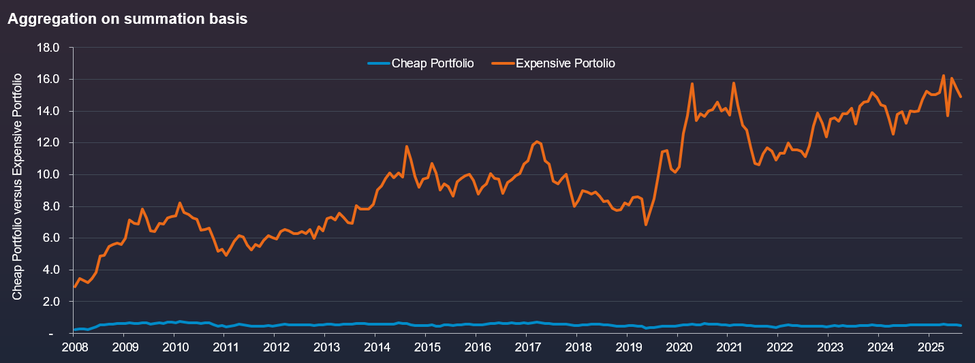
Source: Fidelity International, MSCI, 30 June 2026. Based on actual monthly universe available at each point in time for these indices. At each month-end, stocks ranked on Price to trailing 12-month book value. Most expensive decile as the top 10% of names and the cheapest quartile as the bottom 25%. Aggregation of the data in the charts using summation basis where the relevant numerator and denominator components were summed across the bucket to derive the group-level valuation. Past performance is not an indicator of future returns.
One example is Medlive, a company that has built China's largest medical research platform. Pharmaceutical companies use the platform for targeted academic marketing, creating a business with a long runway for growth. Yet when we invested, the company's cash holdings were almost equal to its market capitalisation, meaning the market was placing very little value on the underlying business despite its continued double-digit growth.
Indonesia is another market where we continue to see compelling value. Our Indonesian holdings trade on an average price to earnings ratio of around seven times while offering dividend yields of approximately 8.5%. In other words, the dividend yield is higher than the valuation multiple we are paying. Those valuations do not reflect the quality of many of the businesses.
Bank Central Asia is a good example here. It has built one of the strongest deposit franchises in Indonesia, supported by a conservative underwriting culture and a long track record of generating returns on equity of more than 20%. Combined with a strong balance sheet and an attractive valuation, it is the type of high-quality business that, in my view, offers a meaningful margin of safety.
These are not businesses you discover by screening a database. You have to understand how they operate, how they create value and whether management can continue to allocate capital well over time. Fidelity's extensive on-the-ground research capability allows us to build that conviction and take meaningful positions when we believe the opportunity is compelling.
Why I remain confident
Experience has taught me that periods like this are inevitable. Whenever one theme dominates the market and leadership becomes increasingly narrow, my performance tends to lag. That has happened before and I have no doubt it will happen again. Every cycle feels exceptional while you are living through it, but market leadership changes over time.
Thirty years on, Fidelity Asian Values continues to follow the same investment philosophy. While markets and market leadership will continue to change, I remain convinced that buying good businesses, run by good management teams and purchased with a meaningful margin of safety remains the best way to generate attractive long-term returns for shareholders.
|
Past Performance (%) |
|||||
|
Jul 21 - Jul 22 |
Jul 22 - Jul 23 |
Jul 23 - Jul 24 |
Jul 24 - Jul 25 |
Jul 25 - Jul 26 |
|
|
Net Asset Value |
3.9% |
11.4% |
3.2% |
12.4% |
6.1% |
|
Share Price |
-3.4% |
17.3% |
-1.7% |
17.0% |
7.8% |
|
MSCI All Country Asia ex Japan Small Cap (N) Index |
-5.6% |
7.5% |
13.7% |
7.1% |
9.1% |
Past performance is not a reliable indicator of future returns.
Source: Morningstar as at 31.07.2026, bid-bid, net income reinvested.
©2026 Morningstar Inc. All rights reserved. The MSCI All Country Asia ex Japan Small Cap (N) Index is a comparative index of the investment trust.
Important information
The value of investments and the income from them can go down as well as up, so you may get back less than you invest. Past performance is not a reliable indicator of future returns. Changes in currency exchange rates may affect the value of investments in overseas markets. Fidelity Asian Values PLC can use financial derivative instruments for investment purposes, which may expose the trust to a higher degree of risk and can cause investments to experience larger than average price fluctuations. This trust invests more heavily than others in smaller companies, which can carry a higher risk because their share prices may be more volatile than those of larger companies. Investments in emerging markets can be more volatile than other more developed markets. The shares in the investment trust are listed on the London Stock Exchange and their price is affected by supply and demand. The investment trust can gain additional exposure to the market, known as gearing, potentially increasing volatility. Reference to specific securities should not be construed as a recommendation to buy or sell these securities and is included for the purposes of illustration only. This information is not a personal recommendation for any particular investment. If you are unsure about the suitability of an investment you should speak to an authorised financial adviser. Investors should note that the views expressed may no longer be current and may have already been acted upon.
News & Insights - Asian Values PLC
Annual Results for the year ended 31 July 2026
During the twelve-month period ended 31 July 2026, Fidelity Asian Values PLC …
Citywire Big Broadcast: Why discipline matters in extreme markets
Nitin Bajaj, Portfolio Manager of Fidelity Asian Values PLC, joined Citywire’…
Navigating market extremes through disciplined value investing
How a disciplined value approach can navigate Asian markets while avoiding cr…